
The Meeting Matters Team · 2026-11-14
If you are wondering how to become a psychologist in Pakistan, the route is clear but takes several years, and it needs practical training as well as degrees. Requirements vary by university and province, so always check with the institution you are applying to.
The steps in more detail
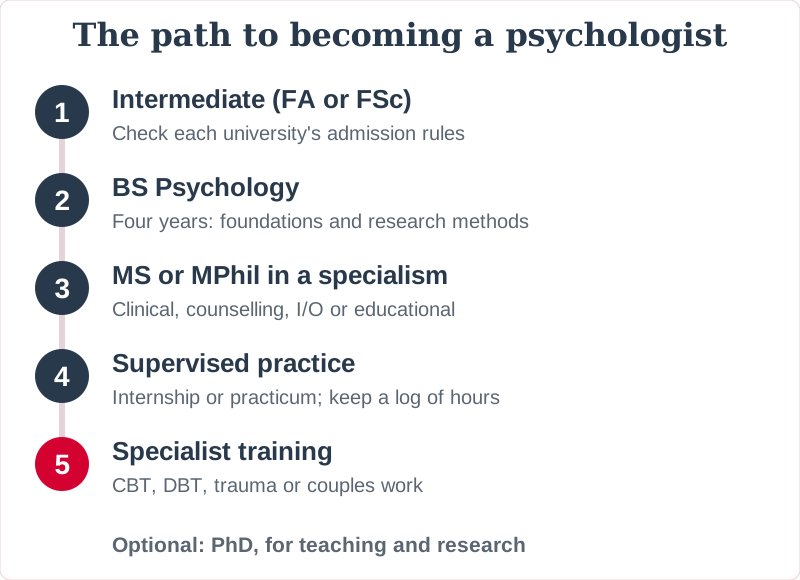
- Intermediate (FA, FSc or equivalent). Most universities accept students from several streams for BS Psychology, but admission rules differ, so check each prospectus.
- BS Psychology (four years). It covers general, developmental, social and abnormal psychology, research methods and statistics, and an introduction to counselling. A degree alone does not make you a clinical psychologist, but it opens the door.
- MS or MPhil in a specialism. Choose between clinical psychology, counselling psychology, industrial and organisational psychology, or educational and child psychology. If you want to be a therapist, pick a programme with a supervised internship or practicum and ask how many supervised hours it includes.
- Supervised practice. This turns knowledge into skill: assessing clients, building trust, handling hard sessions and keeping notes. Train with an experienced psychologist in a hospital, clinic or counselling centre, and keep a log of your hours.
- Specialist training. Many psychologists then train in CBT, DBT, trauma-focused therapy or couples work, through workshops and supervised casework. See what a CBT-based practice looks like.
A PhD is optional. It suits people who want to teach, research or hold senior academic posts, but it is not needed to practise as a therapist.
Psychologist, counsellor or psychiatrist?
| Psychologist | Counsellor | Psychiatrist | |
|---|---|---|---|
| Training | Psychology degrees (BS, then MS or MPhil) with supervised practice | Counselling training, often at diploma or master's level | Medical degree (MBBS), then specialist training in psychiatry |
| Main work | Assessment and talk therapy | Supportive talk therapy for everyday difficulties | Diagnosis and treatment, including medication |
| Prescribes medicine? | No | No | Yes |
For a fuller explanation, see psychologist vs psychiatrist and psychologist, therapist or counsellor.
- Ask whether the programme includes a supervised internship, and how many hours.
- Ask where graduates go on to work.
- Be cautious of short certificates that promise to make you a therapist.
- Check how the degree is recognised if you plan to work abroad.
Regulation and checking credentials
Professional regulation of psychologists in Pakistan is still developing, so there is not yet one registration route that works like the UK's HCPC. That is why it matters to check a psychologist's qualifications, supervised experience and training. If you plan to work abroad, each country has its own requirements for recognising overseas qualifications, so look into them early.
Where it can lead
Psychologists work in hospitals, private practice, schools and universities, NGOs, and corporate and employee assistance programmes. Read more in scope of psychology in Pakistan. If you are a psychology graduate looking for experience, see our careers page for current openings. If you are looking for a psychologist rather than training as one, see our team or request an appointment.