
Eeman Sarfraz · 2026-09-13
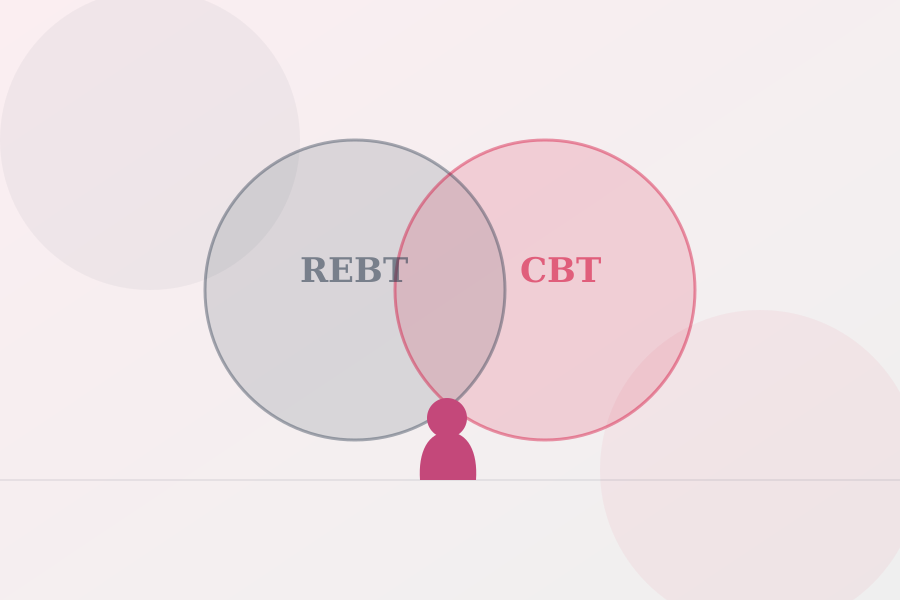
I get asked this a lot, usually by clients who've read something online before their first session: "isn't REBT just CBT?" It's a fair question — Rational Emotive Behavior Therapy (REBT) is technically the older parent of Cognitive Behavioral Therapy (CBT), and the two overlap heavily. But in practice, they lead to a different kind of session, and knowing the difference actually helps clients understand what to expect.
Where They Overlap
Both REBT and CBT rest on the same core idea: it's not events themselves that cause distress, it's the thoughts and beliefs we attach to them. Both are structured, active and present-focused rather than purely exploratory, and both give you practical tools to use between sessions rather than just a space to talk.
Where They Actually Differ
REBT goes straight for the core belief. CBT often works gradually — identifying automatic thoughts, testing them against evidence, and building toward the deeper belief underneath. REBT is more direct: it moves quickly to identify the rigid, absolutist belief driving the distress (the "musts" and "shoulds" — "my partner must never disappoint me," "my family should always approve") and disputes it head-on.
REBT is more philosophical in its framing. A lot of REBT work involves distinguishing healthy negative emotions (disappointment, concern, irritation) from unhealthy ones (rage, panic, despair) that come from the same event — the goal isn't to feel nothing, it's to feel proportionately.
CBT tends to be more structured around specific techniques — thought records, behavioural experiments, graded exposure — built around a particular diagnosis or symptom. REBT is less protocol-driven and more about actively disputing the belief in the room, in real time.
Why This Matters for Family and Relationship Work
In my practice, most of what brings families and couples into a rigid, repeating conflict isn't the actual disagreement — it's an unstated "must": "my spouse must always take my side," "my child should never talk back," "my in-laws shouldn't be this involved." These rigid demands, more than the specific disagreement, are usually what keeps the same fight recurring. REBT's directness at identifying and disputing exactly this kind of belief is often what actually shifts a stuck family or relationship pattern, rather than just improving how an argument is communicated.
Which One Do I Actually Use?
In practice, I don't treat this as an either/or. I lean on REBT's directness when a rigid belief is clearly driving repeated conflict, and draw on broader CBT techniques when someone needs a more gradual, structured approach to a specific pattern. The certification matters less to a client than whether the approach actually fits what they're dealing with — which is really the point of asking a therapist rather than choosing a modality off a list.
If You're Not Sure Which You Need
Most clients don't come in asking for REBT or CBT by name — they come in stuck in a pattern they can't seem to break, whether that's with a partner, a parent, or themselves. You can read more about my approach on my profile, or book a session to start the conversation.
Living outside Islamabad? You can also see a psychologist in Lahore or a psychologist in Karachi online, in Urdu, English or Punjabi.
About the Author

Eeman Sarfraz
Clinical Psychologist — Family & Relationship Counselor (CBT & REBT)
I'm a Clinical Psychologist dedicated to providing evidence-based, client-centered care, with a particular focus on family and relationship counselling. My therapeutic approach is grounded primarily in Cognitive Behavioral Therapy (CBT) and Rational Emotive Behavior Therapy (REBT), helping individuals, couples and families identify unhelpful thought and communication patterns, develop healthier coping strategies, and create meaningful, lasting change in how they relate to each other. I hold a professional certification in Rational Emotive Behavior Therapy (REBT) from the Complementary Therapists Accredited Association (CTAA), Membership No. 10662322. My practice integrates structured, research-backed interventions with empathy, collaboration, and respect for each client's unique experiences. My goal is to provide a safe, non-judgmental and confidential space where you feel heard and understood -- whether you're working through something on your own, or navigating it together as a couple or family.
What Eeman helps with: